 Raffael YÜContact
BYAKUYA
Between movement
and stillness.
A photographic journey through Tokyo, Gunma and Niigata. Shot with a Ricoh XR7 and assembled into a 40-page photobook, BYAKUYA observes the quiet distance between people, places and time.
Explore the project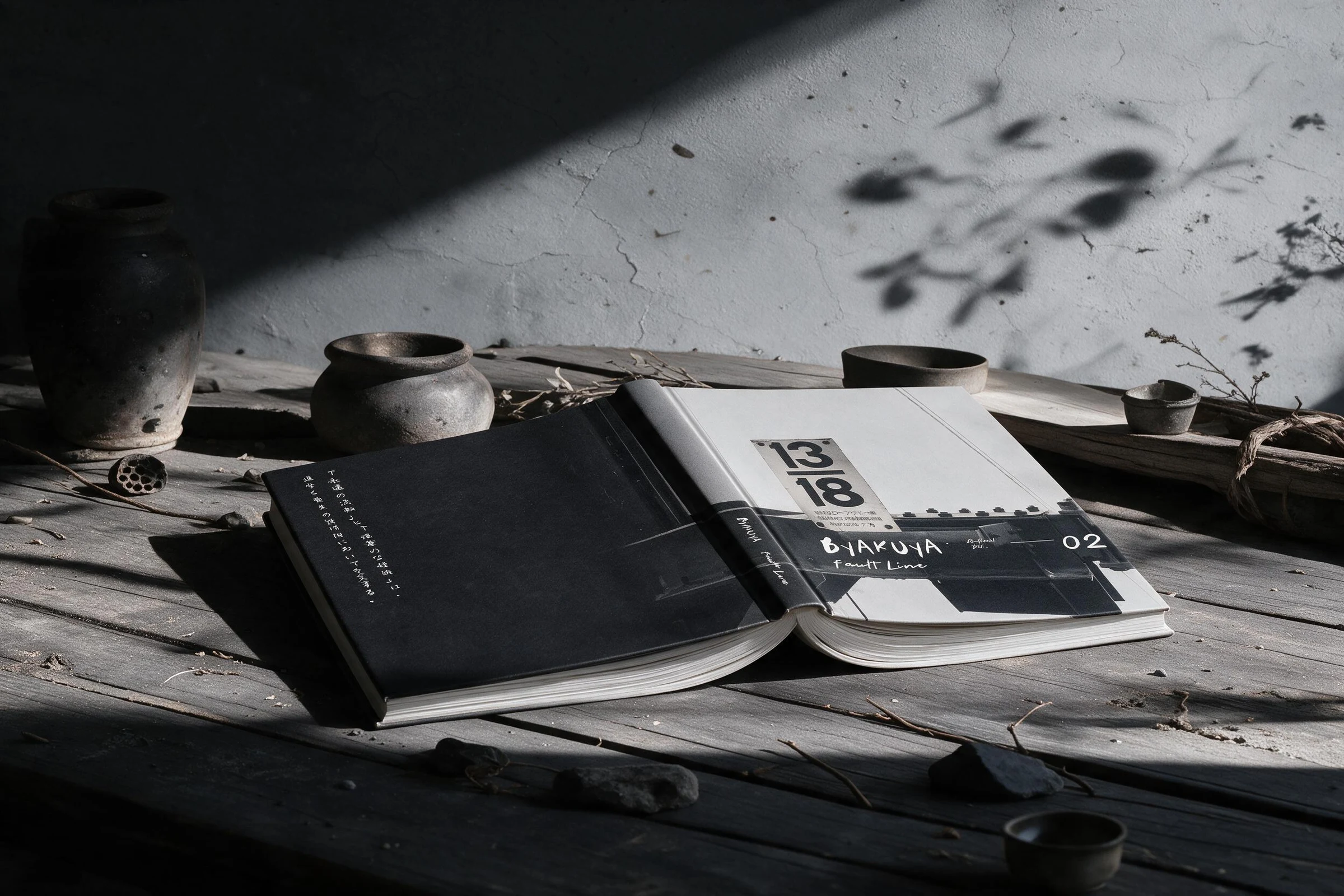
Two worlds.
An invisible line.
Crowded streets and mist-covered landscapes share an unexpected sense of separation. The series looks for connections between them: a lone figure, an empty platform, a structure that seems to disappear into its surroundings.
Make space for looking.
Restrained typography and generous margins slow the reading pace. Wide spreads give way to smaller photographs, letting density and emptiness shape the sequence as much as the images themselves.
The things we pass by.
A shrine, a cemetery, a landscape in mist. These fragments form an open-ended account of changing places, inviting the viewer to notice what sits between the obvious destinations.
A closer look.
Concept, process and the decisions that shaped the project.
Project introduction
Moving between the crowded streets of Tokyo and the mist-covered landscapes of Gunma and Niigata, the series explores the invisible divisions that emerge between people, places and the passage of time.
Photographed with a Ricoh XR7, the collection brings together architectural structures, fleeting human encounters and quiet rural environments. Each image becomes a fragment of a larger narrative about isolation, memory and the changing relationship between society and its surroundings.
Presented as a 40-page photobook, BYAKUYA uses restrained typography, considered sequencing and generous negative space to allow the photographs to speak with their own rhythm.
The Concept / Between Two Worlds
The project began with a journey through the contrasting environments of urban and rural Japan.
In Tokyo, dense architecture, transportation networks and crowded public spaces revealed an unexpected sense of separation. In the countryside, mist-covered valleys, quiet settlements and traces of abandoned infrastructure suggested a different relationship with time.
Rather than presenting these places as opposites, BYAKUYA explores the subtle connections between them , where movement meets stillness, and where progress coexists with the gradual disappearance of familiar landscapes.
Photographic Direction
The series adopts a restrained visual language built around monochromatic tones, architectural framing and atmospheric contrast.
Human figures often appear small within larger environments, emphasising the scale of the built world and the distance between individuals.
In the rural photographs, softened light, layers of mist and natural textures create a quieter visual rhythm, allowing absence and silence to become subjects in themselves.
Together, these images form a meditation on the relationship between people and place.
Editorial Design
The photographic series is presented as a 40-page publication, where image sequencing and negative space play an essential role in shaping the narrative.
Minimal typography, asymmetrical compositions and carefully controlled image placement establish a deliberate reading pace.
Some photographs occupy expansive double-page compositions, while others sit quietly within large areas of white space.
This shifting visual rhythm reflects the underlying tensions of the project , between density and emptiness, movement and stillness, connection and separation.
Closing Reflection
BYAKUYA does not attempt to offer a definitive interpretation of Japan's changing landscapes.
Instead, it invites viewers to observe the overlooked moments that exist between destinations: an empty platform, a solitary figure, a structure disappearing into mist.
These moments suggest that the traces of change are not always dramatic. Sometimes, they are found in the quiet spaces we pass without noticing.
The Wok
A familiar table, far from home.